Showing posts with label NCAA. Show all posts

Monday, April 21, 2014

Q&A with Deputy Athletic Director Robert Ceplikas on the Northwestern Unionization Case and its Impact on Dartmouth


After football players at Northwestern University, with assistance from the National College Players Association advocacy group, moved in January to unionize, the university’s administration fought their efforts with legal action. I sat down last week with Dartmouth's Deputy Athletics Director Robert Ceplikas ’78 to discuss the Northwestern unionization case and its relation to Dartmouth athletics.

JS: How do you think the Northwestern Unionization case, which has received national attention, will impact Dartmouth?

RC: It won't have any direct impact because it only applies to athletic scholarships so the Ivies are immune from that since we don't offer athletic scholarships. Now this is my opinion, but I don't think it will hold up in the long run.

JS: There was an interview with the President Emeritus of Northwestern where he said the school could drop its sports programs. Do you think that would happen?

RC: I think that's a little extreme. I think it's a lot more likely Northwestern would maintain its programs and drop its scholarships.

JS: Could the right to unionize be extended to non-scholarship athletes?

RC: I have not seen any interpretation that would lead non-scholarship athletes to be affected by this anyway. The very basis of the ruling was that it's the scholarship that makes the student an employee.

JS: What if the case does make it's way to the Supreme Court and stands?

RC: Let's just say, hypothetically, that the ruling does get upheld all the way to the Supreme Court, then the main impact on the Ivies will be that the really selective, private institutions that are most affected, the Northwesterns, the Dukes, the Stanfords, they'll suddenly be looking for a very different type of athletic conference to compete in. They'll drop their athletic scholarships and they'll look for a conference like the Ivy League. It's not inconceivable, even though again I don't think this will actually happen to begin with, but if it did, it wouldn't be inconceivable that some of those schools would come knocking on the Ivy League's door and express some kind of interest, if not joining the Ivy League itself, in making some scheduling agreements because they'll be looking for competition from other non-scholarship schools that have similar academic philosophies. That could be a pretty major change if it ever came to that.

Friday, April 11, 2014

Dartmouth Softball Squeaks Out Close Win Over Boston University


In preparation for a four-game series this weekend against Yale, Dartmouth squeaked out a close 5-4 non-conference win over Boston University Wednesday.

Three pitchers pitched from the mound with Ashley Sissel ’17 starting before ceding control to Alex Jarvis ’16, who picked up her second win this season. Sissel allowed six hits and two runs to go with four strikeouts, while Jarvis allowed just two runs on two hits. However, the two runs allowed BU to climb back into the game, and was what prompted the switch to Morgan McCalmon ’16.

McCalmon, the Ivy League Player of the Week for the past two weeks, earned the save by holding BU scoreless the final two innings. She finished having allowed one hit after facing seven batters.

Sophomore Lauren Hynes pitched an uneven, albeit complete, game in a losing effort to go 12-11 on the season. Hynes finished with 10 hits, five runs, six walks, three errors and two strikeouts.

As has been Dartmouth’s modus operandi since its conference schedule started, the Big Green started the scoring in the first with a Katie McEachern ’16 single down the right field line. Kristen Rumley ’15 beat the throw home to score and put Dartmouth in an early 1-0 lead.

Neither team scored until the fourth inning when BU took its first and only lead of the game.

BU manufactured its equalizing score by slowing working around the bases following a bunt by freshman Brittany Younan. Younan eventually scored before when freshman Gabi Martinez singled to left field. BU scored once more when senior Amy Ekart reached home after senior Brittany Clendenny hit into a double play.

Dartmouth responded almost right away when Alex St. Romain ’14 homered to center field to tie the game. Dartmouth slowly built a two run lead over the course of the inning as McCalmon and Alyssa Jorgensen ’17 scored an unearned run on a muffed throw.

After three quick BU outs, Dartmouth returned to the plate to score what would turn out to be the game-winning run. Rumley’s single to right field scored Jorgensen to make the score 5-2.

In a valiant effort by BU’s batting order, BU cut the deficit to one with scores by Ekart and Martinez. Ekart scored on a fielder’s choice while Martinez reached home on a fielding error by Karen Chaw ‘17. BU ultimately ended its attempt to tie the game in the sixth when senior Jayme Mask was called out at third for leaving the base early.

In the final frame, with the pressure cranked up high, McCalmon coolly struck out the first two BU batters before a ground out closed the game.

Wednesday, February 5, 2014

NCAA Helps SMU Basketball Player to Visit Mother Before Her Military Deployment

Markus Kennedy
Southern Methodist's Markus Kennedy couldn't have had a more perfect day. He followed up a career performance with a heart-touching moment where he was allowed to say good-bye to his mother one last time before she deployed overseas.

As FOX Sports Southwest's Keith Whitmire writes, the sophomore led SMU in a surprising 87-72 upset of then-No. 22 Memphis that featured 21 points and 15 rebounds. Kennedy then got on a place to Philadelphia to say good-bye to his mom.

Kennedy's mother, Barbara, is an Air Force sergeant and on Monday, she was leaving for an eight-

month deployment in Kuwait for her third tour of duty. Her first two tours were in Germany and Korea when Kennedy was younger.

Kennedy didn't know he would be going to Philadelphia to say his goodbyes until after the game. NBC Sports' Rob Dauster reports Kennedy said, “They surprised me after the game. They told me I had a ticket to go home. That’s all I needed to know. Rushed in the shower, got my clothes, and I was on the way to the airport. I didn’t ask any questions, I just said thank you to who I had to say thank you to.”

Kennedy quickly contacted his aunt while getting ready to fly. Together, they coordinated just how they would surprise his mother.

During a going-away party for his mom, Kennedy's aunt organized a game where his mom was blind-folded and she needed to feel each family member's face and guess who he or she was. Barbara was blindfolded when Kennedy snuck in the room and kneeled down to make himself seem shorter.

What next occurred was a touching and tearful reunion between mother and son while family members looked on around them.

The entire reunion wouldn't have been possible if not for the efforts of the SMU staff and the good graces of the NCAA, which for once demonstrated leniency for all the right reasons.

Kennedy didn't have the funds to pay for a place ticket and would have been relegated to saying good-bye over the phone. Head coach Larry Brown called Kyle Conder, SMU's Senior Associate AD for Compliance who started the process of applying for a legislative relief waiver.

Normally such waivers are granted to students with financial difficulties in the event of a family death or serious illness. Conder admits that Kennedy's application was the first time he's handled a request due to military deployment. Included in the application were statements from Kennedy and his aunt as well as a copy of Barbara's Air Force orders.

The rest is history. The NCAA granted the waiver, SMU arranged the flight and Kennedy wished his mom farewell. In the past few years, the NCAA has been criticized for all the times its been difficult to work with but this time, the NCAA deserves considerable credit for giving mother and son one last happy memory together in person until they see one another again.

Sunday, February 2, 2014

Dartmouth Survives Princeton Rally to Win 5-3

Photo courtesy of The Dartmouth
Dartmouth (4-15-3, 3-11-1 ECAC) rebounded from last night's embarrassing loss to Quinnipiac with a big 5-3 win over Princeton (4-17-0, 3-11-0 ECAC). Princeton also lost its Friday night game, a 3-2 affair that Harvard had led 3-0 late in the third. Dartmouth’s win lifted the Big Green out of last place in the ECAC.

Dartmouth exploded in the first period, racing out to a 3-0 lead in the first 20 minutes. In the first six minutes, Dartmouth took numerous close shots, keeping the sell-out crowd in Thompson Arena on the edge of its seat.

The Big Green looked like a completely different team compared to Friday night, and played how the preseason polls predicted.

In his first home match against Princeton, Grant Opperman ’17 netted a well-placed shot 5:57 into the game over senior Sean Bonar’s shoulder, igniting the crowd and causing a rain of tennis balls onto the ice.

“It was awesome,” Opperman said. “It was a good play on the power play. There was a great screen. I was lucky enough to be the guy on the spot and pick up the puck and get it in the back of the net. But it was awesome seeing all the tennis balls coming down.”

Opperman’s power play goal was Dartmouth’s first of the calendar year and first in its last 24 opportunities. Dartmouth would go on to add another power play goal in each successive period.

It also turned out to be Eric Neiley ’15’s first time on the ice for the tennis ball toss. Saturday night was Neiley’s first action since the 1-1 Cornell draw as he served a two-game suspension.

“It feels good,” Neiley said. “You never want to sit out. You just want to help the team in any way you can. It’s good to be back and I’m glad I could help out. Tonight was a fun game to be back for.”

There was a momentary scare when Neiley was crosschecked from behind which knocked him down into the net. The goalpost struck his neck, stinging it and sending him to the bench for the rest of the first period. He would later return after the period break and play a big part.

Dartmouth finished the first period with a major 22-5 shot advantage.

45 seconds into the second period, Brandon McNally ’16 redirected a shot from Neiley, netting Dartmouth’s second power play of the night. McNally’s goal would prove to be the game winner.

From there, the second period proved to be Princeton’s.

“Princeton took advantage of some of our turnovers in the second period,” Gaudet said. “We made a few of them in the offensive zone while trying to make a play.”

Princeton refused to give up, battling back with three goals from senior Alec Rush, junior Tyler Magueri and senior Andrew Calof before the second period ended. Several other shots threatened to enter Dartmouth’s net but didn’t.

“I’d be lying to you if I said I wasn’t nervous, because it’s funny how the game ebbs away a little bit and it’s not from a lack of effort,” Gaudet said. “But to regroup going into the third period was really important. We just kept the play in front of us. I thought Princeton played a good game but they weren’t a threat in the third period.”

Jesse Beamish ’15 proved to be the hero of the night, netting his second goal of the night on the power play during the third period. Beamish’s shot from the left circle bounced off Bonar’s leg pads and rolled slowly into the net, sealing the win.

“In a one-goal game, they’re a power play or a shot off a bad angle that hits somebody and it doesn’t have to be a pretty goal,” Gaudet said. “That was just a huge play to get a puck into the net.”

Princeton would pull Bonar from the net to add an extra skater with 2:22 left but never managed to score. Unfortunately, Dartmouth was unable to get a good shot off at the empty net but successfully prevented Princeton from getting multiple shots with the extra skater.

Dartmouth would finish the third period with a 19-3 shot advantage, finishing with a 48-20 advantage.

Dartmouth’s penalty kill also rebounded from the previous night’s Quinnipiac game, thwarting all four of Princeton’s chances.

Kruger allowed three goals in 20 shots but was able to pick up his first career win with Dartmouth’s offensive outburst. Kruger’s Princeton counterpart, Bonar, matched his career high with 43 saves as Dartmouth attacked the goal all game long.

Dartmouth’s 48 shots set a new season high. Its previous high this year came in the season opener when Dartmouth managed 40 shots against Princeton.

Both sides played aggressive all night long, and it showed in the combined 10 penalties both teams took.

Dartmouth travels to Harvard next Friday for its only game of the week. A win over Harvard and a St. Lawrence loss will create a three-team logjam for ninth place in the ECAC.

As for Princeton, the Tigers will prepare for two home games against St. Lawrence and Clarkson.

Friday, January 31, 2014

No. 3 Quinnipiac Annihilates Dartmouth to Seize Conference Lead


No. 3 Quinnipiac overwhelmed an injury-decimated and over-matched Dartmouth squad 8-1. The game was a microcosm of Dartmouth's entire season, and was the hockey equivalent of a perfect game for Quinnipiac.

The rout started from the very first face-off as senior Connor Jones scored the game's first goal in just eight seconds, setting a school record for fastest goal. The Bobcats never looked back, reeling off another five goals by the end of the second period and forcing Dartmouth to change its goalie.

Three of Quinnipiac's goals were scored in a timespan of just three minutes.

"Quinnipiac is an excellent team," Dartmouth head coach Bob Gaudet said following the game. "I thought from the opening face-off Quinnipiac was outstanding. We didn't have any answers and that's my jobs."

Dartmouth's lone goal came long after the game's outcome was no longer in doubt. The point seemed to only antagonize Quinnipiac as they would net another two easily before the night's end.

Dartmouth entered the game needing to capitalize on power play opportunities to remain competitive. Except Dartmouth couldn't score on any of its power plays as Quinnipiac's penalty kill was too good. Quinnipiac entered Friday with a penalty kill of 91 percent, while Dartmouth is now scoreless in its last 23 power plays.

"We're better than we showed but they have an outstanding team," Gaudet said. "They presented us a lot of problems in terms of their skill level and quickness."

Dartmouth hopes to rebound from tonight's defeat with a win against Princeton tomorrow night at 7:00 p.m. The game will be well attended by Dartmouth students because of the traditional "tennis ball toss" after the team's first goal.

Quinnipiac's win and losses by Union and Colgate means Quinnipiac holds sole possession of first place in the ECAC. 

Wednesday, January 15, 2014

Fanni Szabo Remains Humble While Bolstering Dartmouth's Women's Basketball Team


Fourteen games into the season, injuries and illnesses have seemingly crippled the Dartmouth women’s basketball team’s chances of an Ivy Championship. But don’t tell the players that. For a team that hasn’t finished a season with a winning record since 2008-2009, Dartmouth is mathematically alive to make a surprise run for the title.

Dartmouth has played just one conference game, a 73-63 loss to Harvard last Saturday. Szabo was the team’s second leading scorer with 10 points, all in the second half, while Nicola Zimmer ’14 scored 16. Lakin Rowland ’16 was third, earning nine points and seven rebounds until she fouled out late in the contest.

However, Dartmouth’s downfall was allowing 52 points in the paint and a 9-0 run by Harvard midway through the second half. Harvard further sunk Dartmouth’s chances for a stunning comeback by hitting 92.3 percent of its free throw attempts.

But all is not lost. Two major factors support a potential Dartmouth conference title. First, the team has started to get healthy at just the right time to make a run, and second, the team will rally around the extraordinary season of Fanni Szabo ’17.

Szabo has quietly had a phenomenal freshman year, leading the team with 17.6 points per game. She has three games of 30-plus points, two of which were Dartmouth’s only wins so far.

Her propensity for scoring aligns well with her preferences. If she had to choose between playing offense or defense, she would choose offense. And her favorite defensive move? The steal, so that she can go back on offense.

However, her favorite part about the game, and playing for Dartmouth, is her teammates.

But you could never guess that Szabo was the team’s offensive star just from talking to her, a testament to her team-first attitude.

“She’s so skilled that she automatically makes everyone better in practice, and when she scores like 30 points and she acts like she didn’t even play in the game,” Lakin Rowland ’16 said. “I think she’s just a ball player and she makes it more about the team than her personal performance. She just wants to win.”

Szabo’s unselfish demeanor also translates into a humble demeanor off the court.

“She’s very sincere and modest,” Ruby Hopkins ’17 said. “It’s really refreshing to have her around to give a perspective on life. I never knew about how well she’s performed in basketball until I heard about her performances from other people. When I congratulate her on them, she redirects the attention away from herself by saying nothing could have occurred without the team.”

Szabo entered Dartmouth with a long list of accomplishments and accolades for both her basketball skills and for academics.

Szabo was born and lived all her life in Hungary. Basketball wasn’t her only sport growing up, nor was it the first sport she loved.

She participated in Track & Field as a sprinter but stopped after the fourth grade, but she recalls more fondly her attempt to play tennis. She wanted to play tennis in order to emulate her brother who was also a tennis player. However, the tennis coach told Szabo that she was too young at the age of six and that she should return when she was older.

As you can guess, she never returned and the rest is almost history. Szabo started to play basketball and gradually fell in love with the sport, following a path that eventually led her to Dartmouth.

Along the way, Szabo attended Britannica International School, which is the longest established British school in Hungary. While at Britannica, she was named the Top Student and Top Athlete in Hungary in 2012 and received an award for Academic Excellence.

She played three seasons with UNIWA Euroleasing Sopron where she won the First League National Hungarian Championship and the Hungarian Cup. She finished second in the First League Hungarian-Slovakian Championship, was named to the U18 All-Tournament Team and the list goes on, the entirety of which can be found on her Dartmouth Athletics Department biography.

Szabo was talented enough to attend any number of schools and could have become a star player for premier national powerhouse programs like Baylor University or the University of Connecticut. Instead, she chose Dartmouth, in part because of how important her academic progress is to her.

“From the first moment I decided to come to the US, I told myself that I would only come if both academic and athletics were a high priority,” Szabo explained. “When I looked at schools, I only looked at schools where both areas were important. When Dartmouth reached out to me, I knew I wanted to come here. The fact women’s basketball didn’t do well last year didn’t affect my decision.”

Szabo has only been in the United States since August but she’s enjoyed her time at Dartmouth. She loves her classes and right now she’s trying new subjects to discover her academic interests in addition to a psychology major. While at Britannica, she was restricted to four subjects and couldn’t explore different subjects.

“I love Dartmouth,” Szabo exclaimed. “It’s so much colder here than in Hungary but I’ve gotten used to it. I love the people here and they’re just so helpful and supportive. My teammates and my floor-mates, all the people I’m friends with, make me feel like I’m at home.”

Her teammates have also enjoyed spending time with her as they watch her experience new holidays and new events for the first time.

“It’s fun to be with her when she experiences new things,” Rowland said. “Like Thanksgiving. Thanksgiving isn’t something that occurs in Hungary, so she went to a teammate’s house for thanksgiving. She’s been very open about it.”

Hopkins lives on the same freshman floor as Szabo and, as a result, has developed a nice friendship with her.

“It’s always fun to talk with her,” Ruby Hopkins ’17 said. “She’s one of the people I’ve really been glad to get to know on the floor.”

As much as Szabo’s teammates have taught her, Szabo has enjoyed giving her teammates the occasional lesson in Hungarian which has the additional side effect of making her feel more at home.

“She really loves her team and they’ve been able to get along well,” Hopkins said.

For instance, Szabo teaches her teammates the occasional Hungarian phrase. After several attempts, the women’s basketball team learned how to say “Believe in yourself,” although initially, their words, according to Szabo, sounded like the complete opposite.

For her next challenge, I suggest she might try teaching at least one of her teammates the 40-plus letter Hungarian alphabet. But she probably won’t submit her teammates to learning the alphabet though considering how much she loves her team.

“I love how I’m able to see my teammates every part of the day,” Szabo said. “Last term, I took a class with one of my teammates, and this term as well. In Hungary, we didn’t have that in high school. I was always far away from my team when we weren’t practicing. It’s nice to have my teammates here all around me because it makes us know each other better.”

Szabo has been the driving force for Dartmouth’s offense and, in some ways, the fortunes of the women’s basketball team rise and fall based on her performance.

Szabo scored more than 30 points during both of Dartmouth’s victories. In her second career game, she scored 31 points, setting a new freshman scoring record in a thrilling 66-62 victory over Vermont.

Ten games later, Szabo broke her own record with 34 points in Dartmouth’s 76-72 victory over UMass in the Blue Sky Classic. Szabo registered one more game of 30+ points when she scored 33 against Providence in a 72-82 loss.

Dartmouth’s offense completely disappears when she’s been shut down by the opposing defense. When Syracuse shut out Szabo for the entire game, Syracuse won big 88-47. The two other games Szabo scored fewer than 10 points were against La Salle and Hartford, both Dartmouth losses by double digits.

“Everyone has those games where it’s just not falling for you but she just continues to play,” Rowland said. “I think it’s indicative of her character as a person and her style of play. Even if it’s not going in offensively, she can still find ways of contributing defensively.”

Every time after a lackluster performance, Szabo has bounced back with a vengeance and demonstrated a clear positive growth mindset.

“She plays smart. She doesn’t really get into foul trouble,” Rowland said. “She leads by example. She’s not one to criticize or be very vocal. When she is vocal, it’s more of a positive tone. I think the coaches appreciate her. She plays a lot and she’s a great ball player.”

Now at the halfway point of the season, the team has started to gel, in part, according to Szabo, due to the coaching efforts of first year head coach Belle Koclanes.

“I believe in the new coaches and I believe in my teammates,” Szabo said. “I love playing for my coaches. They are just so positive and they bring this high energy to every practice and every game. I really think we’re getting better as a team. I really like the new culture they’re creating. I think it’s going to show how much effort they put into making us better.”

Even if Dartmouth’s season continues to unravel, the team has a bright future thanks to Szabo, Koclanes and the rest of the underclassmen. And despite the abysmal record, the women’s basketball team has yet to give up.

“We work every day to make winning an Ivy Championship possible,” Szabo said. “Our record doesn’t show it because we’ve had a lot of sicknesses and injuries. Now, all of us are able to play and it’s going to make us a better and more consistent team. I see the improvement we’re making as a team on and off the court and I know we’re able to win it.”

Szabo and the Big Green return to action on Saturday afternoon at 2:00 p.m., traveling to Newark, N.J. to take on the New Jersey Institute of Technology, the first match of a six-game road slate. Dartmouth’s next home game won’t be until Valentine’s Day, Feb. 14 against Cornell.

Monday, January 13, 2014

The Story of Joe Moglia: From Defensive Coordinator to CEO to Head Coach


From 1981 to 1983, Joe Moglia was Dartmouth’s defensive coordinator, coaching the defense as Dartmouth earned two Ivy Championships. But by season’s end, Moglia abandoned football for the financial sector in order to support his family, and now, 30 years later, Moglia returned to the sidelines, achieving his lifelong dream of coaching a college football team.

Moglia’s story came to national prominence when Sports Illustrated’s Monte Burke featured Moglia when his Coastal Carolina Chanticleers prepared to take on the 11th ranked FBS-program South Carolina Gamecocks.

Coastal Carolina was a trendy upset pick against the rising SEC power only to be demolished 70-10 by South Carolina. Despite the lopsided defeat, Moglia’s legacy and inspirational story remain untarnished. Few would have expected a person of Moglia’s background to live the life he has enjoyed.

The oldest of five children, Moglia grew up in New York City where his father operated a small fruit stand and his family lived in a small, two-bedroom apartment. By the time Moglia graduated high school, he knew he wanted to become a head football coach.

Equipped with a bachelors in economics from Fordham and a masters in secondary education from the University of Delaware, Moglia worked his way through the assistant coaching ranks, making stops at NYC’s Fordham Prep, Delaware’s Archmere Academy and Pennsylvania’s Penncrest High School.

He moved on to his first defensive coordinating position at Pennsylvania’s Lafayette College before directing Dartmouth’s defense under head coach Joe Yukica, who coached Dartmouth from 1978 to 1986.

Moglia’s defense was considered one of the best in the nation, helping Dartmouth to consecutive Ivy Championships in 1981 and 1982.

Despite his professional success, Moglia’s personal life was starting to crumble as his wife, who he had married at 19, divorced him. Moglia was forced to live in the unheated storage room at the top of the Davis Varsity House as he couldn’t afford a separate apartment on his $33,000 salary.

In 1983, Moglia’s final year of coaching, Dartmouth tied for third in the Ivy, going 4-5-1 (4-2-1 Ivy).

During the offseason, Moglia was offered a defensive assistant position at the University of Miami who was coming off its first national championship title in school history after winning the Orange Bowl under head coach Howard Schnellenberger.

Schnellenberger then left Miami for the ill-fated United States Football League and was replaced by Jimmy Johnson. Johnson would go on lead Miami to a second national championship before moving on to the NFL’s Dallas Cowboys where he won two Super Bowls. The core players Johnson built around at both Miami and Dallas would combine for another three national titles without Johnson.

Moglia turned down the Miami job in order to make the jump to the financial world so that he could provide the financial resources to raise his four children. At 34 years old, Moglia entered the financial sector, enrolling in a financial training class at Merrill Lynch that included 24 MBA graduates and one former defensive coordinator.

In his 17 years at Merrill Lynch, he climbed the ladder until he was a member of the executive committees for both institutional business and private client business. He was responsible for all investment products, the insurance company, 401(k)s and the middle-market.

Moglia, who was quickly making a habit of taking risks, abandoned his lucrative position at Merrill Lynch to become the CEO of TD Ameritrade in 2001, an online broker that had barely survived the dot-com bubble bust. It was a move many considered crazy but Moglia couldn’t climb any higher up the ladder at Morgan Lynch.

During his seven-year tenure as CEO, TD Ameritrade’s assets grew from $24 billion to over $300 billion and its market capitalization increased from $700 million to $12 billion, all the while recording five consecutive years of record earnings. Capitalizing on merger and acquisition opportunities, he led TD Ameritrade in two of the largest acquisitions: Datek Online Holdings in September 2002 and TD Waterhouse in January 2006.

“If we were a football team, it would be like we won two championships,” Moglia said according to a 2010 article published by Joe Wertheim. “And it wasn’t like we were doing it as USC or Nebraska. It was like we were Wake Forest.”

Thanks to Moglia’s leadership, TD Ameritrade sidestepped the 2008 Financial Crisis when he refused to deal in subprime mortgages despite intense pressure from investors. While E-Trade lost $1.3 billion and Merrill Lynch, Moglia’s former employer, lost $28 billion, TD Ameritrade recorded an $800 million profit.

Just as he was at the top of the financial world, in March 2008, Moglia announced he would step down to pursue other interests, officially vacating the CEO position in September 2008. He still stayed with the company as chairman.

One of Moglia’s claims to fame was the he was one of a few people who published books on football and finance. He wrote The Key to Winning Football: The Perimeter Offense (1981) and Coach Yourself to Financial Success: Winning the Investment Game (2005).

Originally intending to take an extended vacation, Moglia politely refused numerous job opportunities. But when a friend who was a Yale alumnus called to inform Moglia that the Yale head coaching position was open, Moglia was intrigued.

He took a couple months to decide whether he wanted to coach or not, but he eventually decided yes, much to the chagrin of most of his work associates and part of his family. Moglia knew he wasn’t going to be offered a position at a major FBS school, but he believed he was good enough for teams in conferences like the Ivy or the Patriot.

He started shopping his resume around to different college programs, but few were interested because of his 25-year hiatus. He made regular calls to Athletic Directors (ADs) as well as Yale, but Yale never returned the call and decided to hire Tom Williams (Williams has since resigned after a season that featured a scandal regarding a Rhodes Scholarship application).

Terry Holland, then the athletic director at East Carolina, said Moglia’s candidacy raise more questions than it answered, and the only thing working against his resume, which demonstrated all the skills necessary, was the lack of recent experience.

ADs are naturally risk-averse because they need to select coaches that can win games or risk losing their jobs. Moglia’s lack of experience meant few would consider biting.

Kevin White, the AD of Duke University, met with Moglia in early 2009 but decided not to hire him.

“He would be a non-traditional hire,” White explained. “A university would have to see him as a risk that makes sense to take.”

Perception was working against Moglia, who was perceived as a rich person looking for a Saturday hobby.

Eventually, the University of Nebraska allowed Moglia to work as an unpaid voluntary assistant coach and mentor for two years. He broke down game film, attended practices and coaches meetings, wrote copious notes and religiously studied the Cornhuskers’ playbook.

Moglia estimated that he worked 70 hours per week for free, a massive departure from his salary at TD Ameritrade which averaged $14 million annually, topping out at $21 million in 2008.

Eventually, Moglia was hired to his first head-coaching gig, but it was for the Omaha Nighthawks of the now-defunct United Football League. He coached the Nighthawks to a 1-5 record, losing games to Marty Schottenheimer and Jim Fassel, but beating Dennis Green.

Then the UFL folded and Moglia was on the job search again, giving college football one more try. Fordham and Florida Atlantic expressed interest but they hired different candidates.

In 4th & Goal, a biography of Moglia written by Monte Burke, Moglia admitted, “as much as I wanted to spend the rest of my life coaching, I did not want to spend the rest of my life looking for a job.”

And then Coastal Carolina of the FCS Big South Conference called.

David Bennett, the school’s first head coach, had been surprisingly fired despite Coastal Carolina’s 7-4 record and 3-3 conference record. Bennett had become more recognized for a viral video than as a serious head coach, leading to his termination.

David DeCenzo, Coastal Carolina’s university president, hired Moglia to be the school’s second head football coach in the school history, with a five-year contract that paid him $175,000 annually.

An agent for former Coastal Carolina players now in the NFL called the hiring “an insult to the entire coaching profession.”

DeCenzo was fully aware of the potential repercussions of his gamble and willing to accept them.

“This is either the smartest or dumbest decision I’ve ever made,” DeCenzo said at the time.

White, Duke’s AD, had been completely right. Only a school willing to break tradition could hire Moglia.

Coastal Carolina was a unique situation because it started its football program in 2003 and lacked the major traditions of other Division I programs. There were no major boosters available to protest and withhold money because the program was still building itself. Hiring Moglia wouldn’t torpedo recruiting efforts like it would at major schools like Alabama or Texas.

Even then, Moglia was filling big shoes. Bennett had, quite literally since 2003, built a winning program out of nothing.

Alan Black of the Bleacher Report heavily criticized Moglia’s hiring. Black wrote that the obvious reason Moglia was hired was due to his wealth and connections to the financial sector.

“It’s a shrewd business deal, but completely tramples the integrity of college sports,” Black wrote. “If the NCAA is all about athletic and academic integrity and amateurism, it sure doesn’t show in Coastal Carolina’s hire… How are the Chanticleer football players supposed to trust their own head coach when they know that he isn’t qualified to lead them and essentially bought his way into the position?”

As it would turn out, Black’s analysis was wrong and Moglia continued Coastal Carolina’s winning ways. But at the time, little evidence suggested Moglia would exceed Bennett.

Bennett coached Coastal Carolina to a 63-39 record, a 27-16 conference record, two FCS playoff appearances and four conference championships, three of which came in the program’s first four years. He also defeated traditional FCS powers like James Madison, Furman and Wofford.

However, Bennett was unable to win a playoff game, something Moglia achieved in his first year, defeating Bethune-Cookman 24-14.

But Moglia’s short tenure hasn’t been a cakewalk.

His first season at the helm started out rocky as Coastal Carolina went 2-4, including an embarrassing 55-14 defeat to Appalachian State. Just as naysayers seemed right, Moglia’s team started clicking, reeling off five wins by an average of 30 points.

Moglia finished his first year with an 8-5 record, including the school’s first playoff victory before losing 63-35 to Old Dominion in Round 2. He was named the Big South Conference’s Coach of the Year.

Expectations were higher for Moglia his second year, but he met them, registering two playoff victories and a 12-3 record.

Coastal Carolina recovered from the embarrassing loss against South Carolina by advancing to the FCS Playoff Quarterfinals.

In the playoffs, Moglia defeated Bethune-Cookman and Montana. Moglia’s season ended after a 48-14 Quarterfinals loss to North Dakota State. NDSU just won its third consecutive national championship after defeating Towson on January 4th to extend its winning streak to 24. Despite the lopsided loss, Coastal Carolina still finished the season ranked seventh in the FCS.

As Moglia’s success continues, it will become a matter of “when,” not “if,” Moglia will receive a call from an FBS program.


Disclaimer: The quotes presented in this article are courtesy of 4th&Goal (the biography of Moglia) and different articles published by Sports Illustrated, the Bleacher Report and U.S. News. URLs will be provided upon request. 

Sunday, November 24, 2013

Recap: Dartmouth Football Finishes Season with 28-24 Win over Princeton


Dartmouth’s Class of 2014 finished its career with a stunning upset against Princeton (8-2, 6-1 Ivy). Players celebrated after Dalyn Williams ’16’s kneel down sealed the 28-24 victory with snow angels and somersaults as the snow accumulated on the field.

“I’ve very proud of the group,” head coach Buddy Teevens said. “It was a great win for us and a great win for our program.”

Dartmouth now leads the overall series 46-43-4 after snapping Princeton’s eight-game win streak and preventing Princeton from seizing full control of the Ivy championship. 

“We didn’t do enough,” junior Quinn Epperly said. “We lost. It’s a terrible way to end the season for these seniors. It really tarnishes a lot of what we did over the year.”

With 23 wins, including 16 conference games, the Class of 2014 finished its career with the most wins for any class in 15 years and defeated Princeton all four years.

Princeton entered having lost to Dartmouth the previous three years. But it seemed Princeton, ranked No. 19 in the FCS Coaches Poll, seemed prepared to break the losing streak with its prolific scoring offense. Princeton’s only loss prior to Saturday was 29-28 to Lehigh.

Epperly led Princeton’s offense in scoring at least 50 points in five of the last eight games. In Princeton’s game against Cornell, Epperly set an NCAA record with 29 straight completions to start a game. 

“We knew they had the best offense coming in and we thought we had the best defense coming in, so we knew something’s got to give,” Chrustic said. “If everybody just does their job and doesn’t bite on some fancy things, we’ll do well.”

Last week, Princeton demolished Yale 59-23, earning a share of the Ivy League championship, its 10th in program history and first since 2006. It also broke the Ivy League single-season scoring record when senior Philip Bhaya returned an interception 34 yards for the score with five quarters to go.

“We already felt like we won the title,” head coach Bob Surace said. “We beat the team [Harvard] we tied with. Dartmouth is a good team and it was a toe-to-toe battle but they got us at the end.” 

But on Saturday night, Princeton scored just 24 points despite running 104 plays on offense, the most against Dartmouth in at least 40 years. Princeton finished the year with an Ivy League scoring record to 437 points. 

Dartmouth built up a 21-0 lead, but almost lost it when Princeton reeled off 21 unanswered points to tie the game early in the third. Williams scored a 17-yard touchdown on the ground midway through the third for what would turn out to be the game-winning score as Princeton could respond with only a field goal.

The game opened up with a three-and-out by both offenses. Williams tried to find Bo Patterson ’15 deep on third down but Patterson was unable to secure possession before stepping out of bounds while Evan Chrustic ’15 sacked Epperly on third down to force a Princeton punt.

Situated at midfield after Princeton’s punt, Dominick Pierre ’14 broke two big runs of 11 and 34 yards to put Dartmouth at the three. Two goal-line plays later, Pierre powered into the end zone from one yard out, putting Dartmouth on top 7-0. 

On the drive, Pierre surpassed 1,000 yards rushing for the season, and became the first Dartmouth player in program history to score a rushing touchdown in every game.

After another Princeton three-and-out, Williams tried to hit Robbie Anthony ’14 on the corner but sophomore Matt Arends intercepted the pass.

On Princeton’s ensuing drive, Epperly rolled left on the play-action and tried to find junior Connor Kelley. Chase Womack ’14 jumped on the underthrown pass but dropped the potential pick-six. Dartmouth held strong when Epperly threw to senior Roman Wilson on fourth down and Troy Donahue ’15 knocked the ball out of Wilson’s hands.

Dartmouth was unable to capitalize on the turnover on downs, going three-and-out after Williams misfired to Jordan Are ’15. 

Dartmouth was given a second chance when Princeton was flagged for roughing the kicker, placing Dartmouth at midfield. However, Dartmouth went backwards fast after a holding penalty on first down and Williams was sacked on second. Dartmouth almost converted the third-and-27 when Williams heaved it deep to Patterson, but the ball flew through Patterson’s outstretched arms.

On Dartmouth’s next drive after a Princeton three-and-out, Williams located Patterson deep down the right sideline for 56 yards, increasing Dartmouth’s lead to 14. Patterson caught the ball at the 19 and fought off a Princeton defender the rest of the way.

Epperly responded on Princeton’s next attempt with a laser to senior Des Smith deep across the middle to the Dartmouth 43. Epperly was fortunate when an interception was ruled incomplete when the Dartmouth defender was ruled out of bounds despite maintaining possession. Chrustic deflected Epperly’s fourth-down pass at the line, giving Dartmouth the ball at its 17.

Dartmouth mounted its longest drive of the game, starting when Kyle Bramble ’16 went up the middle on Dartmouth’s first play before cutting to the left sideline and running 41 yards. Williams finished off the drive with a five-yard read-option touchdown run, running untouched through a massive hole in the middle, extending Dartmouth’s lead to 21.

For Princeton’s next drive, head coach Bob Surace pulled Epperly for junior Connor Michelson. Michelson fared no better after going three-and-out when Eric Wickham ’15 delivered a massive hit to Michelson’s blindside, sacking him to force a Princeton punt.

Dartmouth’s attempt to increase its lead ended when Dean Bakes ’14 was unable to pull in Williams pass, forcing Dartmouth to punt.

Surace reinserted Epperly, but also kept Michelson on the field in order to run a trick play. Epperly handed the ball off to Michelson, who rolled right and found a receiver for the first. Michelson was then pulled out, and Epperly continued marching Princeton down the field until Wilson took Epperly’s pitch five yards into the end zone. With just under five minutes in the first half, Princeton cut Dartmouth’s lead to 21-7.

Dartmouth’s offense was unable to find its rhythm and run time off the clock. During the punt, Dartmouth originally forced a fumble but the officials ruled the ball dead due to lack of forward progress.

Princeton’s luck stayed alive as time ticked down. Two major penalties gave Princeton 30 free yards, including one that should have been offset by a false start from Princeton’s right tackle, setting Princeton up at the Dartmouth 34.

Epperly misfired twice to wide-open receivers in the end zone before hitting junior Seth DeValve at the one. Epperly pushed the ball into the end zone to cut Dartmouth’s lead to seven with 10 seconds left in the half.

Like the opening drives of the first half, both offenses went three-and-out for their second-half opening drive. 

Dartmouth’s opening drive ended when Williams was sacked by senior Elijah Mitchell. Williams was hurt on the play and left for one series.

Midway through the third quarter, the snow started falling as Epperly hit junior Matt Costello for 30 yards to tie the score at 21. During the drive, Princeton converted twice on fourth-and-1. 

After a Dartmouth three-and-out, Princeton drove to its 44, and on fourth down, Epperly rolled right and was stopped short of the first. On every previous fourth down attempt, Epperly just did a quarterback sneak.

Williams reentered the game and found Patterson for a big first down on the right sideline. Pierre then broke a tackle and bounced outside before going out at the 17. On the next play, Williams scored to make the score 28-21 with 4:51 left in the third. 

On the scoring play, Williams kept the ball and ran right before making the cutback to the left and sprinting the width of the field. After outrunning sophomore Anthony Gaffney, who was the only Princeton defender in position to stop Williams, Williams dove for the score, putting the ball just inside the left pylon.

On Princeton’s ensuing drive, Cody Fulleton ’16 knocked the ball loose from Mills, and Donahue emerged from the massive pileup with the ball at the 49.

Williams marched the offense down the field quickly, finding Pierre in the flat for a big gain that put Dartmouth at the Cornell 24. A holding penalty and a sack pushed Dartmouth back, and on fourth down at the 31, Williams tried to find Are in the end zone but underthrew him under pressure, turning the ball over on downs.

Princeton went three-and-out after Dartmouth knocked away two Epperly passes.

The snowfall stopped by the beginning of the fourth quarter as Dartmouth’s drive started at the Cornell 46 while the temperature dropped below freezing. Dartmouth’s drive ended quickly after Williams launched the ball deep into the end zone and Princeton intercepted it.

Princeton reached midfield but Epperly’s pass sailed through his receiver’s hands on third down.

Dartmouth was unable to sustain a drive after Williams was sacked on third down. 

Princeton very quickly marched down the field, breaking into the red zone after starting with the ball at the Dartmouth 48. The snow started once again as Princeton lined up for a fourth-down attempt.

Epperly’s pitch to Wilson was good for the first down, putting Princeton at the four. Princeton was unable to punch the ball into the end zone and sophomore Nolan Bieck’s 23-yard field goal cut Dartmouth’s lead to four with 6:36 remaining.

Despite an excellent return by Womack to the Dartmouth 39, Williams was unable to spark the offense and run time off the clock, punting back to Dartmouth with 5:45 left.

Chrustic knocked down Epperly’s third-down pass, forcing Princeton to punt with 4:22 left.

With the ball at the 10 and the snow falling heavier and sticking on the field, Williams broke free for 37 yards up the middle. With time on its side, Dartmouth started using the entire play clock between each play. 

On third down, Williams pitched the option to Brian Grove, who raced to the Cornell 27. Dartmouth turned the ball over on downs with 45 seconds left after Pierre was stopped for a four yard loss on fourth down.

Starting with one timeout and needing to race 76 yards to win the game, Epperly threw two incompletions before Garrett Waggoner ’13 intercepted Epperly’s third-down pass, icing the win with 24 seconds remaining.

At one point, the snowfall was so thick that Epperly admitted he was unable to reach the signals from the sideline and missed a couple reads. 

Chrustic knocked three of Epperly’s passes at the line as Dartmouth’s defensive line harassed Epperly all afternoon.

“That was just the most fun I’ve ever had playing football,” Chrustic said. “It snowed and I thought that was to our advantage. It was such a great atmosphere. Best game all year.” 

Pierre earned his fifth 100-yard rushing game of the season after running 112 yards on 28 carries with a long of 35. Williams added another 57 yards and two scores. 

Princeton’s leading rusher was Epperly, who kept the ball 20 times for 41 yards. Mills was second on the team with just 30 yards on the ground.

Overall, Dartmouth outran Princeton 239 to 140. However, Princeton outgained Dartmouth 403-331 in total offense as Dartmouth passed for just 92 yards. 

Williams completed just four of 15 for 92 yards, two interceptions and the big 56-yard score to Patterson. However, Williams made plays when most needed.

“I think I was efficient at making plays but not efficient enough,” Williams said. “The majority of the game, I was taking shots and it didn’t go our way every time. But at the end of the day, we won.”

By contrast, Epperly threw 56 times, completing 26, for 242 yards and two scores. DeValve provided Epperly the most consistent target, pulling in nine passes for 115 yards.

“We didn’t execute well enough,” Epperly said. “I didn’t throw the ball well enough. They were very physical upfront.”

Neither team did well on third down as Princeton converted six of 24 while Dartmouth went four of 15. Princeton compensated by attempting eight fourth-down tries and converted five of them.

“They made more plays,” Surace said. “Field position hurt us. It was a tough day to throw and [Dartmouth] ran the ball better than we did. [Dartmouth’s] explosive plays really hurt us.” 

As a result of Saturday’s win, Dartmouth also seized control of sole possession of third place, because Harvard and Princeton tied for first, in the Ivy League’s final standings.

“It’s probably one of the most unselfish teams I’ve ever coached,” Teevens said. “This was a statement game. I believe we are a championship-caliber team.”

Earlier Saturday afternoon, Harvard demolished Yale 34-7, to move into a first-place tie with Princeton, who had defeated Harvard earlier in the year. Princeton and Harvard finish the 2013 season sharing the Ivy Championship title.

The Ivy League’s remaining Saturday games included a surprise 42-41 upset by Cornell over Penn and a 48-7 Brown rout of Columbia. Columbia finished the season without a single win and just 73 points scored.

Saturday, October 12, 2013

Louisville's Title Hopes Gone; So are Bridgewater's Heisman Hopes


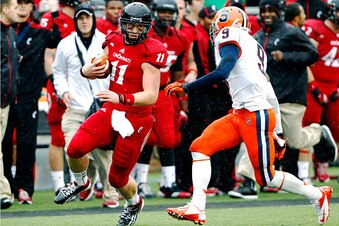
The Louisville Cardinals remain undefeated after Thursday night's 24-10 win over Rutgers University, but Thursday's pyrrhic victory cost Louisville a BCS National Championship game appearance. In front of a national TV audience, Louisville had the chance to showcase their worthiness against a decent opponent but flopped. Now, Louisville's goal is even farther away than it was at the beginning of the season and will only get more distant.

With six games left in the regular season, the schedule gets much tougher as three of Louisville's opponents have at least four wins apiece. Cincinnati, Central Florida and Houston stand in the way, and strong performances from any one of them will prevent Louisville from traveling to Pasadena. BCS voters will not choose the Cardinals over a one-loss Pac-12 or SEC team. Even a 12-0 Ohio State squad would be selected over Louisville based on appearance and strength of schedule.

Cincinnati has a decent team and is probably a notch better than both Kentucky and Rutgers. However, Cincinnati is the easiest threat to handle, if only because of the adversity the Bearcats are going through. In head coach Tommy Tuberville's first season, Cincinnati lost starting quarterback Munchie Legaux to a knee injury, the Bearcats were upset by previously winless South Florida and redshirt freshman Brian Flick died tragically in a car accident.

Houston's potential to upset Louisville is a mystery because the Cougars have yet to play a strong opponent. Next week's game against Brigham Young will give a more accurate picture of Houston. One thing remains constant though, Houston's high-powered offense will test Louisville's defense.

Right now, Louisville's biggest threat is Central Florida who has already routed Akron, a team that almost upset Michigan, and upset Penn State. Two weeks ago, Central Florida almost shocked South Carolina but fell short, losing by just three points for its only loss of the season. With a defense that is giving up 16.6 points per game, Central Florida will harass Bridgewater all night and force him to make more mistakes that Rutgers did.

Louisville's title hopes rested on the arm of Heisman hopeful quarterback Teddy Bridgewater. Bridgewater needed to play perfectly every game of the season, but against Rutgers, he threw for 310 yards and two touchdowns. Instead, Louisville only won on a big performance from its defense while Bridgewater led an offense that turned the ball over three times. Louisville's defense suffocated Rutgers quarterback Gary Nova, registering eight sacks and four interceptions.

Per Gary B. Graves of ABC Sports, "It was a decent performance,"Bridgewater said. "I left a couple of throws on the field. I battled adversity, but it was a decent performance. It was a great team effort, the guys laid it all on the line."

Bridgewater threw an interception in the end zone and missed a wide-open Damian Copeland that could have put Louisville inside the five-yard line.

Bridgewater acknowledged that Louisville could have, and should have, played much better. Per Fox Sports' Greg Couch, "I believe we got our message through," Bridgewater said. "(But) we left about 17 points on the field. We should've easily put up 40 points tonight."

Head coach Charlie Strong knows that Thursday night's performance likely cost Louisville the Championship appearance, and he tried to spin the victory as one voters should approve of during his post-game interview.

Per Couch's report, “We came away with a victory and it was a good game. Rutgers played well also. If you’re sitting there with someone watching the game, you’re probably saying, 'This is a really good football game.'"

For a team to have a chance at the National Championship, it needs a bit-time, marquee victory. Louisville's only major victory this season was against SEC cellar-dweller Kentucky, a 27-13 win that should have been larger for a prospective championship team.

Louisville was a dark-horse candidate to play in the BCS Championship during the preseason thanks to last season's bowl win over Florida and Bridgewater's Heisman hype. But just like Bridgewater's shot at the Heisman, Louisville's shot at the Championship is gone with the wind, regardless of whether they win the American Athletic Conference or not.

This article was originally published by me on the Bleacher Report.

Friday, October 11, 2013

Cincinnati Football: Breaking down the Bearcats' Potential 2013 Bowl Outlook


With three more wins, the Cincinnati Bearcats will qualify for their seventh consecutive bowl game. However, last Saturday's 26-20 upset to previously winless South Florida makes some wonder just how far Cincinnati will advance this season.

Cincinnati was picked to finish second in the preseason American Athletic Conference media poll. At 3-2 with one conference loss, Cincinnati must treat every game as a must-win, starting tonight against Temple. If the Bearcats lose one more game before the season finale against Louisville, Cincinnati will find itself in the Belk Bowl.

By running the table, the Bearcats will set up a winner-take-all with Louisville for the title and, more importantly, a BCS bowl game. Rutgers and the Bearcats themselves are the biggest obstacles standing in the way of a Cincinnati-Louisville title game.

Louisville might be vulnerable enough for Cincinnati to mount the upset bid. Thursday night, Louisville barely remained undefeated as Rutgers forced three turnovers and contained Teddy Bridgewater for most of the night, likely torpedoing his Heisman hopes. Rutgers could have won if not for the Scarlet Knights committing four turnovers themselves.

A BCS appearance would provide a much happier ending to an extremely turbulent season where very little has gone right. In head coach Tommy Tuberville's inaugural season, Cincinnati lost starting quarterback Munchie Legaux to injury, was blown out by Illinois and barely squeaked by rival Miami (OH) with a 14-0 win.

Following the Miami (OH) game, freshman offensive lineman Ben Flick died in a tragic auto accident. Playing with heavy hearts, Cincinnati traveled to South Florida only to lose a heartbreaker. But hope exists for the Bearcats after they rallied against South Florida and scored 14 points in the fourth quarter.

Excluding the blowout at Illinois, the defense has been Cincinnati's strong point, allowing 17.4 points and an impressive 251 yards per game. Most of Cincinnati's issues reside with the offense.

According to Tuberville, the offensive issues include getting beaten up front, younger receivers not running routes correctly and an inconsistent running game.

"Normally the team with the most adversity is the team that comes out on top," Cincinnati running back Ralph David Abernathy IV said in an interview with Tom Groeschen of the Cincinnati Enquirer. "To me, the only way to go for us is up."

Cincinnati must rely on its defense and a run game currently averaging 200 yards per game until quarterback Brendon Kay demonstrates the ability to carry the offense. Kay has an easy three-game series against Temple, Connecticut and Memphis to become more confident. Cincinnati should win all three games while simultaneously qualifying for a bowl game.

After Memphis, Cincinnati's schedule toughens with Southern Methodist, Rutgers and Houston before the showdown with Louisville. Cincinnati's final four games will determine which bowl the Bearcats will play in.

CBS Sports' Jerry Palm predicts Cincinnati will play in the Pinstripe Bowl on December 28th against Notre Dame. USA Today agrees, though predicts Cincinnati will take on West Virginia.

Bill Bender of Sporting News projects Cincinnati versus Missouri in January 4th's Compass Bowl. ESPN's Mark Schlabach and Brad Edwards also place Cincinnati in the Compass Bowl but differ on the opponent—Mississippi State and Vanderbilt, respectively. Backing Edwards up is Jason Kirk of SBNation who also pits the Bearcats against the Commodores.

Scout.com leaves Cincinnati completely out of the postseason.

PREDICTION: Cincinnati loses to Rutgers and Louisville. Plays in the Belk Bowl versus ACC #5.

This article was originally published by me on the Bleacher Report.

Thursday, October 10, 2013

Pac-12 Conference Clash Preview: Washington State vs. Oregon State


Washington State and Oregon State enter Saturday night's Pac-12 clash with four wins each. This year's face-off looks to be much more explosive than last year's 19-6 Oregon State victory over Washington State.

Benefactors of a soft first-half schedule, Saturday offers one team the opportunity to establish itself as a rising power. The loser will still have work to accomplish in an increasingly powerful Pac-12 conference that can challenge the SEC for dominance.

Saturday's matchup features two of the top eight passing games in the FBS, according to ESPN. Neither Oregon State nor Washington State runs the ball very often or effectively, ranking 121st and 122nd in the nation respectively.

Last week's aerial battle between Washington State and California totaled over 1,000 yards, and Saturday's tilt could produce similar results.

For several years in a row, Oregon State has fielded a powerful offense and fields one again this season.

After several forgettable seasons, Washington State is in the second year of head coach Mike Leach's rebuilding process. In just his second year, Leach's implementation of the Air Raid is nearing completion. A win against Oregon State would place WSU in prime position to play its first bowl game since 2003.

WSU should put on a fireworks display against an Oregon State defense giving up 31.6 points and 400 yards per game. Even worse, the Beaver defense surrendered 49 points to FCS-school Eastern Washington.

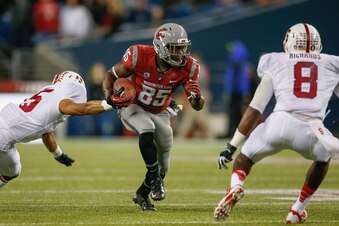
Under the guidance of Leach, Washington State owns the eighth-ranked passing attack, averaging 359.7 yards each week. In order to win, quarterback Connor Halliday needs as big a game as last week. He cannot afford to make mistakes like he did during his rough performance last year in Corvallis.

"I think it had more to do with Connor," Leach said during Washington State's weekly Monday press conference. "Going into Oregon St., he never really started or played very much. So the fact that he's started and played whatever it is, I think six full games, it's definitely helped him and he's way ahead of where he was last year."

Oregon State quarterback Sean Mannion leads the second-ranked aerial assault, throwing for 2,000 yards, 21 touchdowns and just two interceptions. Despite being torched by Stanford for 55 points just two weeks ago, the Cougar defense has only allowed 20.8 points per game and hopes to challenge Mannion's early season success. But if WSU's defense fails, Saturday night will rapidly devolve into a shoot-out.

PREDICTION: Washington State 42, Oregon State 35

This article was originally published by me on the Bleacher Report.

Tuesday, October 8, 2013

Washington State Cougars Potential Bowl Outlook


In his second year, Mike Leach's overhaul of the Washington State football program is showing impressive signs of development in all areas from defense to the passing game and, surprisingly, the run game. As a result, Washington State should qualify for its first bowl game since 2003.

Leach inherited the team from Paul Wulff, who went 9-40 overall and 4-32 in conference play, good for the worst win-loss record of any coach in Cougars history. After experiencing some initial bumps during his first season where his team went 3-9, Leach has seemingly begun righting the ship and put the Cougars in position for their first six-win season in seven years.

The Cougars schedule should help Leach earn two more wins and qualify for a bowl berth. Over the course of the next two months, Washington State will play Oregon State, No. 2 Oregon, Arizona State, Arizona and Utah before taking on No. 16 Washington in the Apple Cup.

Washington State will likely lose against Oregon and Washington barring a major upset, but the Cougars have the potential to defeat the remaining four teams, or at least go 2-2.

Excluding Stanford's 55-point outburst, Washington State's defense has been playing much stronger than last year, allowing just 14 points per game. Including the Stanford game bumps the average up to 20.8 points per game, which is still good for 35th in the FBS.

The defense's best game was against Southern California, ranked 25th at the time. Thanks to a pick-six and a blocked field goal, the Cougars won 10-7 and held the Trojans to their lowest point total in the past 10 years after averaging 45.4 points per game against the Cougars in their last seven meetings.

Even the run game is performing twice as well. Although ranked 122nd in the nation with 58.7 yards per game, which is characteristic of Leach's Air Raid, the run game has chalked up 352 yards with six touchdowns compared to the 349 yards and six touchdowns earned throughout the entirety of last season.

Although no Mike Leach-coached team will ever win a game by running the ball, the run game is strong enough to keep opposing defenses honest and refrain from blitzing multiple defenders or dropping seven or eight into coverage.

The most important factor behind Washington State's development is the improved quarterback play of Connor Halliday who spearheads the eighth-ranked passing attack in 2013, according to ESPN.

Halliday split time last season with current Buffalo Bills backup Jeff Tuel. Combined, Halliday and Tuel completed 58.2 percent of their passes for 3,965 yards, 23 touchdowns and 21 interceptions.

In six games, Halliday has surpassed his performance from last year.

Season      CMP  ATT   YDS    CMP%    TD    INT    SACK    QBR    Adj. QBR
2013          189    290    1993    65.2        13    10         9           51.7         65.8
2012          152    291    1878    52.2        15    13        22          34.5         35.3

Leach's Air Raid relies on excellent quarterback play. In his first season as the full-time starter, Halliday is proving that he is capable of coordinating Leach's aerial attack.

In his most recent game at California, Halliday completed 41 of 67 passing for 521 yards, three touchdowns and one interception as Washington State routed California 44-22. Halliday bounced back nicely after a lackluster performance two weeks ago against Stanford, setting a school record and climbing to second place in completions and yards. Only former quarterback Alex Brink threw for more yardage in a single game.

"We came out with our hair on fire, but we've got to be able to keep rolling and putting up points for our defense," Halliday said during a post-game interview (via Lew Wright of All Coug'd Up) after leading the Cougars to victory against California. "We had some looks to throw the ball out there today and we had the ball for a long time. That's going to happen in this offense."

If Halliday can cut down on the rate he throws interceptions, he might become as prolific as previous quarterbacks in Leach's system, like Graham Harrell.

ESPN writer Ted Miller agrees that Washington State will earn entry into a bowl game, projecting that the Cougars will play in the Gildan New Mexico Bowl on December 21 against Mountain West (No. 4). Another potential landing spot is the Kraft Fight Hunger Bowl against either BYU or ACC (No. 9).

Anything less than a bowl game would be a disappointment. Next year, though, Leach's program should begin its ascent to levels similarly experienced by Leach's former team, Texas Tech.

This article was originally published by me on the Bleacher Report.